Showing posts with label book reviews. Show all posts

Take Three Girls by Cath Crowley, Simmone Howell and Fiona Wood

Tuesday, October 3, 2017

To say I was looking forward to Take Three Girls would be the understatement of the year. When I found out it was being written I was at first unsure if this was real life or some sort of coma dream. Three of my favourite authors collaborating on a novel does seem very much like something my brain would invent. But luckily for me (and you!), Take Three Girls is a real (and wonderful) novel. (Either that or I'm still in the coma dream.)

Take Three Girls focuses on Ady, Clem and Kate, boarders at a prestigious private girls' school who are thrown together by a school 'wellness' program and who are dealing with a whole slew of issues - including being targeted by a sexist and disgusting website.

I found the novel a little jarring at first - it took me a while to get a sense for each of the girls' voices, and the multiple viewpoints, plus diary entries, plus wellness program sheets, plus excerpts from PSST (the website) made for a beginning that was very busy.

I'm mentioning this because if you pick up this book and struggle through the start - keep reading! Though I read the start slowly, once I was familiar with the characters (and once they had met each other), I found it much more involving and I read the rest in one sitting. The format that had seemed excessive at the start gave the novel depth and realism, and made for a more immersive experience. The character voices are distinct, but work together really well. I would love for these three authors to collaborate again. 

My personal theories, on which author wrote which character are as follows (and completely unconfirmed!): Clem definitely feels like a Simmone Howell character - she writes complex, sometimes-unlikeable girls like no one else. Kate's romance storyline and love interest - I will not give anything away! - felt very much in the style of Cath Crowley and had echoes of Words In Deep Blue. Ady's thoughts on and passion for social justice issues reminded me of the protagonist in Fiona Wood's Cloudwish. Note that it is entirely possible that I am zero for three here, but it's fun to speculate. (Other readers I have discussed this with have had very different interpretations!)

Take Three Girls is a novel I would recommend to any fan of contemporary YA novels - teenagers and adults alike. I think there can sometimes be a tendency for YA now to be aware of the size of its adult audience and (consciously or not) cater to that audience, and though Take Three Girls is a complex and thoughtful novel that engages with themes around feminism and social justice, it is still unashamedly about and for teenage girls.

While each character has a romantic plotline (and I really appreciated Ady's romance storyline and how her bisexuality was depicted in the book), themes of friendship are definitely the focus. It is both very thought-provoking and very accessible - the issues (and they are many!) are never at the expense of the enjoyability of the novel. It's engaging and sincere and uplifting and a novel I hope many, many teenagers read.

Take Three Girls on the publisher's website.

Hexenhaus by Nikki McWatters

Friday, December 2, 2016

A powerful novel about three young women caught in the hysteria of their own times.

In 1628, Veronica and her brother flee for their lives into the German woods after their father is burned at the stake.

At the dawn of the eighteenth century, Scottish maid Katherine is lured into political dissent after her parents are butchered for their beliefs.

In present-day Australia, Paisley navigates her way through the burning torches of small-town gossip after her mother’s new-age shop comes under scrutiny.

While I'm not a big reader of historical fiction, Hexenhaus intrigued me. Hysteria! Witchcraft! Three interconnected stories! It's dark and compelling, and once I started reading, I had trouble putting it down. Knowing its basis in real events made this novel especially disturbing - Veronica, Katherine and some of their family members and other characters are based on real historical figures, and the horrifying 'hexenhaus' (a witch prison, where Veronica's parents are killed in the novel) is based on a place in Bamberg where witch trials were conducted and about a thousand people died. It's awful.

The strongest parts of Hexenhaus are Veronica's and Katherine's stories; the historical fiction seems well-researched, reads easily, and has a strong sense of time and place. While Paisley was a likeable protagonist and her town felt well-drawn, I never quite bought her story; the townspeople's horror about witchcraft isn't something I could imagine in present-day Australia. If their loathing of Paisley's mother was instead motivated by some other social difference (cultural or socioeconomic, perhaps) or financial goal (like some other businessperson wanting the prime real estate of the new-age shop), then it would have been easier to understand. I still enjoyed Paisley's story, but it didn't gel quite as well as the other two. Veronica was my favourite character, and I found her story the most compelling, though Katherine's voice was engaging.

I love the narrative through-line that connects Veronica's, Katherine's and Paisley's stories, and felt that the three worked well together. I think this novel will appeal most to readers of historical fiction. And it is straight-up historical fiction - those put to trial as witches are mostly politically inconvenient, or killed for the economic gain of the witch finder, as it was in reality. No witchcraft here. It merges the historical well with the contemporary, though I would've been more intrigued to read Paisley's story had it been set at a different point in Australian history - perhaps during the early 20th century, when a fear of witches in a rural town might be more realistic. Paisley's story adds a certain lightness - while Veronica's and Katherine's stories are full of death and suffering and tragedy and injustice, ultimately there is hope, through Paisley (it'll make sense when you read the novel). This is a bit of a spoiler alert, but if you're worried Hexenhaus ends too tragically for you to want to read it, rest assured the ending is uplifting. For at least one character.

Hexenhaus is a dark but enjoyable novel which really shines in the historical sections. Well worth a read if you're particularly interested in witch trials, and a nuanced exploration of mass hysteria.

Hexenhaus on the publisher's website.

Everything Is Changed by Nova Weetman

Monday, November 21, 2016


If only we could all go back to the way it was before…

Jake and Alex. Best mates. One terrible mistake. Two lives that will never be the same.

Told in reverse, this powerful and gritty novel moves through the wreckage of a broken friendship, back to the moment when everything changed.

I love a story told out of chronological order, and once I found out Everything Is Changed was told in reverse, I was really curious to see how that was executed. What's awesome about Everything Is Changed is that, even though it's told backwards, it somehow seems totally natural and effortless. Which surely it wasn't; this would be a complicated novel to write. Enough information is divulged to keep the reader engaged, but suspense is still maintained throughout.


Something I really love about Nova Weetman's work (particularly her previous YA novel, Frankie and Joely) is that while there are romantic storylines, they tend to be subplots; really, these are novels about the complexities of friendship. While Frankie and Joely ultimately ends with the central characters resolving their issues and strengthening their friendship, Everything Is Changed ends with Jake and Alex apart, their friendship well and truly over. That's not a spoiler because it happens at the start. While there is a slight moral message, it's really more about the friendship between the characters breaking down (and their respective personal crises as a result of what happens) than about either of the boys learning a lesson.

I think one weakness of back-the-front storytelling is that certain details are repeated in order to orient the reader in time; for example, if this story were told traditionally, we would not have to be told about characters who we have already met at an earlier (later) point. Am I confusing you? I'm confusing me, too. Basically, there's a little repetition so that we don't get confused. The protagonist and his dad play golf with Tony and his dad; at a later point (earlier in time) we're told the protagonist's dad admires Tony's dad. We already know that, from when they played golf, which hasn't happened yet. Make sense?

Apart from that minor gripe, the novel flows well. It's easy to follow, enjoyable and everything being told in reverse gives the events a sort of tragic inevitability while still being engaging. I wanted things to work out differently for the characters, even though they clearly couldn't. I don't like saying that particular novels are for girls or boys based on the gender of the characters - any reader of any gender should be able to enjoy reading about any character of any gender (if the only way a reader can relate to a character is through being the same gender, that's weak writing) - however for readers who want to read about boy characters, Everything Is Changed is terrific. It's about the friendship between two boys going horribly awry, after a terrible thing happens, and it's realistic enough for young readers to feel as if it could happen to them. It's dark, but it's not without hope. An enjoyable and immersive read.

Everything is Changed on the publisher's website.

Clancy of the Undertow by Christopher Currie

Friday, July 1, 2016

In a dead-end town like Barwen a girl has only got to be a little different to feel like a freak. And Clancy, a typical sixteen-year-old misfit with a moderately dysfunctional family, a genuine interest in Nature Club and a major crush on the local hot girl, is packing a capital F.

As the summer begins, Clancy’s dad is involved in a road smash that kills two local teenagers. While the family is dealing with the reaction of a hostile town, Clancy meets someone who could possibly—at last—become a friend. Not only that, the unattainable Sasha starts to show what may be a romantic interest.

In short, this is the summer when Clancy has to figure out who the hell she is.

(I was lucky enough to help launch Clancy of the Undertow at Avid Reader Bookshop in Brisbane way back in December. I've recommended the novel to many people since I first read it, but never got around to posting a review: so here you go!)

I really enjoyed Clancy of the Undertow, and I was really struck by how authentic the voice of Clancy was. I think especially when you have met writers you can get a real sense of authorial voice intruding on the story, so you've got this sense of the intrusion of the author, which can be good and can be bad. In the case of Clancy of the Undertow, it was just Clancy, which made me suspect that Christopher Currie perhaps went on a trip to rural Queensland and discovered a very well-written, quite sad journal written by a gay teenage girl.

I think it's very tempting in Young Adult fiction when you're focusing on the central teenage characters to disappear the parents, because it's just a lot more convenient. What I loved in Clancy was the involvement and realism and nuance of Clancy's relationships with her parents and her brothers, and how that was developed.

Clancy lives in the dead-end town of Barwen, and both the landscape, the actual physical place, and the atmosphere, the attitudes of the townspeople are beautifully evoked. There's a very rich tradition in Australian fiction of romanticising rural Australia, but in Clancy's case her town is just awful and very insular. At the same time, small-town mentality - particularly among youth - seems incredibly accurately captured.

Clancy's brother Angus is a conspiracy theorist and is obsessed with cryptozoology and finding evidence of the existence of the fabled "Beast of Barwen", which is an aspect of the story that's both intriguing and amusing. (I'm not one for conspiracy theories, though I did genuinely believe in the existence of the Yowie as a child.) The dialogue is genuine, and the female friendship is endearing.

It's a gorgeous novel, and yet another example of excellent Australian YA. I wouldn't hesitate to recommend it to both teenaged and older readers.

The War that Saved My Life by Kimberly Brusker Bradley

Tuesday, June 7, 2016

An exceptionally moving story of triumph against all odds, set during World War II.

Nine-year-old Ada has never left her one-room flat. Her mother is too humiliated by Ada’s twisted foot to let her outside. So when her little brother Jamie is shipped out of London to escape the war, Ada doesn’t waste a minute—she sneaks out to join him.

So begins a new adventure for Ada, and for Miss Susan Smith, the woman who is forced to take in the two children. As Ada teaches herself to ride a pony, learns to read, and watches for German spies, she begins to trust Susan—and Susan begins to love Ada and Jamie. But in the end, will their bond be enough to hold them together through wartime? Or will Ada and her brother fall back into the cruel hands of their mother?

This is the sort of novel you feel as if you've read before, but it's comforting in its familiarity. There are a lot of well-worn themes and character journeys here: Ada overcoming physical adversity; Ada and Jamie blossoming once away from their abusive mother; Susan, depressed and reluctant to care for the children, emerging from her grief and coming to love Ada and Jamie. It may lack originality in terms of plot, but it's such a well-executed, enjoyable read I didn't mind.

The beginning is engaging as Ada and Jamie flee their home and the city. Ada's voice is honest and authentic and true. While it's slow-paced through the middle, the ending is satisfying and uplifting and all the heartwarming you hope for. If you're tired of children-in-wartime novels, rest assured that the war is very much background to the story; this is a character-driven novel, which centres around Ada's journey, and is very much focused upon her acknowledging and moving beyond her mother's abuse and her physical limitations.

Ada and Jamie's mother is unrelentingly horrible, and the nature of her horribleness felt slightly far-fetched; it seemed more likely that an awful mother like her would have her daughter's foot operated on so that she could put her to work and profit from her child, rather than insist on shutting her away. By contrast, the woman into whose care Ada and Jamie are placed, Susan, is lovely. Her depressive state felt accurately evoked and her grief over the death of her best friend is dealt with tactfully. Her best friend is implied to have been her partner, prior to her death; I think it's great to see gay women represented in historical children's fiction, even in this limited way.

It's a novel which will engage older primary school students (to whom the themes and plot will seem fresh), but has enough depth and resonance to appeal to older readers, too. It's a lovely little novel to curl up with on a rainy day, that took me back to the novels I read and loved as a child.

The War that Saved My Life on the publisher's website.

Inbetween Days by Vikki Wakefield

Tuesday, April 26, 2016

At seventeen, Jacklin Bates is all grown up. She’s dropped out of school. She’s living with her runaway sister, Trudy, and she’s in secret, obsessive love with Luke, who doesn’t love her back. She’s stuck in Mobius—a dying town with the macabre suicide forest its only attraction—stuck working in the roadhouse and babysitting her boss’s demented father.

A stranger sets up camp in the forest and the boy next door returns; Jack’s father moves into the shed and her mother steps up her campaign to punish Jack for leaving, too. Trudy’s brilliant façade is cracking and Jack’s only friend, Astrid, has done something unforgivable.

Jack is losing everything, including her mind. As she struggles to hold onto the life she thought she wanted, Jack learns that growing up is complicated—and love might be the biggest mystery of all.

So, Inbetween Days is my new favourite Vikki Wakefield novel and, considering how much I love Vikki Wakefield's other novels (check out my review of Friday Brown here), that's saying something. Australian contemporary YA has so many amazing writers, and Vikki Wakefield is up there. She isn't afraid of difficult characters and uncomfortable situations and moral complexity, and her writing is lyrical and beautiful without being inaccessible.

I think something that appeals to me immensely about Vikki Wakefield's work is that it's in-our-world but not-quite-in-our-world. There are things about Jack's life that anyone who has ever been a teenager will easily identify with (especially her insecurity and desire to escape), and her town is one you can imagine driving through on a road trip, but then there are elements that are just a little bit out-of-kilter, just slightly surreal - like the stranger camping by the suicide forest, or the number of tiles in the shop changing. The setting is wonderfully atmospheric. Mobius is like a town in a David Lynch film.

This is definitely one for the older YA reader. In a way, Jacklin and her fierce attitude reminded me of Kirsty Eagar's Summer Skin; Jack, like Jess, is unapologetically herself, but she still makes (many) poor decisions. She is real and raw and insecure and wonderful. The relationships she has with her family and friends are complex and difficult. If you expect characters to be likeable and to behave reasonably, you'll disappointed - but I think the realness and messiness of relationships and family dynamics (particularly between Jack and her mother) are what make this novel so honest and affecting. Also Jeremiah is the loveliest.

Adult readers of literary fiction would enjoy this. I also think it will really appeal to older teenaged YA readers who might have moved on to adult fiction. (It might be a bit confronting for the younger YA reader - it's quite dark, with themes of suicide, and sex is dealt with casually.) It's not straightforward or plot-driven nor does it rely on stock storylines or stereotypes, though it touches on lots of universal themes. Jack's life is dull to her but enthralling to the reader. Her sad, dark, dying town is beautifully evoked. If you can get through all the bleakness, I promise it's heartwarming in the end.

Inbetween Days on the publisher's website.

Iris and the Tiger by Leanne Hall

Monday, April 18, 2016

Twelve-year-old Iris has been sent to Spain on a mission: to make sure her elderly and unusual aunt, Ursula, leaves her fortune–and her sprawling estate–to Iris’s scheming parents.

But from the moment Iris arrives at Bosque de Nubes, she realises something isn’t quite right. There is an odd feeling around the house, where time moves slowly and Iris’s eyes play tricks on her. While outside, in the wild and untamed forest, a mysterious animal moves through the shadows.

Just what is Aunt Ursula hiding?

But when Iris discovers a painting named Iris and the Tiger, she sets out to uncover the animal’s real identity–putting her life in terrible danger.

This book! This lovely, surreal, bizarre gorgeous book! Look at that cover! Read that description! Isn't it just the most splendid thing you've ever seen/read?

If you haven't read Leanne Hall's YA novels This Is Shyness and Queen of the Night, I do believe you are severely missing out and you must address this terrible oversight immediately.

If, however, This Is Shyness and Queen of the Night are a little too Young Adult-y for you, and you want a novel that is Younger Young Adult-y but still has all of the magnificent, surreal goodness of a Leanne Hall novel, you're in luck: Iris and the Tiger is the novel for you. Even though Iris is twelve, and this novel is for readers around her age, older readers will not be disappointed - Iris and the Tiger has adventure and mystery and absurdity and subtlety and will fill you with wonderment, I guarantee it.

If you have read and enjoyed Leanne Hall's other novels, Iris and the Tiger is still the novel for you. If you like stories about girls going on slightly-bizarre adventures, this is the novel for you. If you know a preteen human who likes reading fiction that's a little bit magical, you should give this novel to them. This novel. It is the good weird.

There are so many great things about it: the wonderfully endearing Iris herself, her terrifically bizarre Aunt Ursula, her slightly villainous property-developer parents, the enchanting setting of Bosque de Nubes... and some of the things I loved best are the things I cannot reveal in this review because this novel is so much better when those things are a surprise.

Iris and the Tiger even explores themes like male artists taking credit for female artists' work in a manner that seems totally organic to the story. There's a compelling mystery at the centre of it, and many, many wondrous, imaginative details. I would love to live in a Leanne Hall novel, despite the obvious dangers (there are some terrifying... creatures, I guess?). I'll accept the risks. It's just that magical.

I hope this review gives you a sense of whether it is a novel for you. I was absorbed in the story in a way which is quite rare for me as an older reader. It's fresh and it's gorgeous and it's just A+ younger YA. It's a bit different, but I think there are lots of young (and not-so-young) readers out there who will appreciate it's uniqueness, and the fabulous protagonist, Iris.

Iris and the Tiger on the publisher's website.

The Secrets We Keep by Nova Weetman

Tuesday, April 12, 2016

I don’t know if you’ve ever seen a house burn, but it’s not like anything else … 

Clem Timmins has lost it all – her house, possessions and clothes. Now living in a tiny flat with her dad, she has to go to a new school far from what she knows. 

On her first day, Clem meets Ellie. To fit in, Clem reveals a secret and immediately regrets sharing too much with her new friend. 

How can Clem face everything in her life when all she wants to do is run away?

I enjoyed the beautifully spooky The Haunting of Lily Frost and I loved Frankie and Joely, a lovely contemporary YA exploring female friendship, even more. So I was excited to find out about the release of Nova Weetman's latest novel, The Secrets We Keep. (Nova Weetman is unbelievably prolific. How do people manage a book a year?)

Emily Gale (author of the wonderful Steal My Sunshine) described The Secrets We Keep on Twitter as baby-YA. Which I think is my new favourite label for the reading age bracket known as Middle Grade (which doesn't really mean anything here in Australia, I don't think). It's for 10-14-year-old readers. It's the category of books I most fervently loved as a kid (back when I loved monstrously huge series like The Saddle Club), and I still find really enjoyable and comforting now. (I just read - and loved - Leanne Hall's Iris and the Tiger, a more fantastic story for the same age group.)

Even though it's written for younger readers, The Secrets We Keep tackles some really tricky themes: mental illness, loss, death, grief. It's tactful, it's authentic, it's immensely readable, and something I think would definitely appeal to older primary school kids who like real-world stories. Clementine is endearing, despite her mistakes, and even though a whole lot of difficult, traumatising things happen in her life, the story is ultimately uplifting. The timing of events seems coincidental* but the emotional authenticity of the novel meant this hardly mattered.

The complicated social dynamics reminded me of the difficult friendships between characters in Kate Gordon's Writing Clementine. (I forgot that novel was called Writing Clementine then searched up the name of it... only to remember that Clem was the name of the central character in that novel, too - which might be why I thought of it. Mental illness in the family is another theme that also pops up in Writing Clementine, and is delicately and thoughtfully handled in both novels.) The depiction of being new to a primary school and finding your place when friendship groups seem to already be set in stone is perfect (and agonising). I felt like I was eleven-years-old again.

I'm looking forward to Nova Weetman's next novel, regardless of what she writes next, but I'm certainly hoping for another baby-YA.

The Secrets We Keep on the publisher's website.

* [spoiler] That Clem would confide in Ellie about the death of her mother mere days before the death of Ellie's own mother is slightly too convenient. [end spoiler]

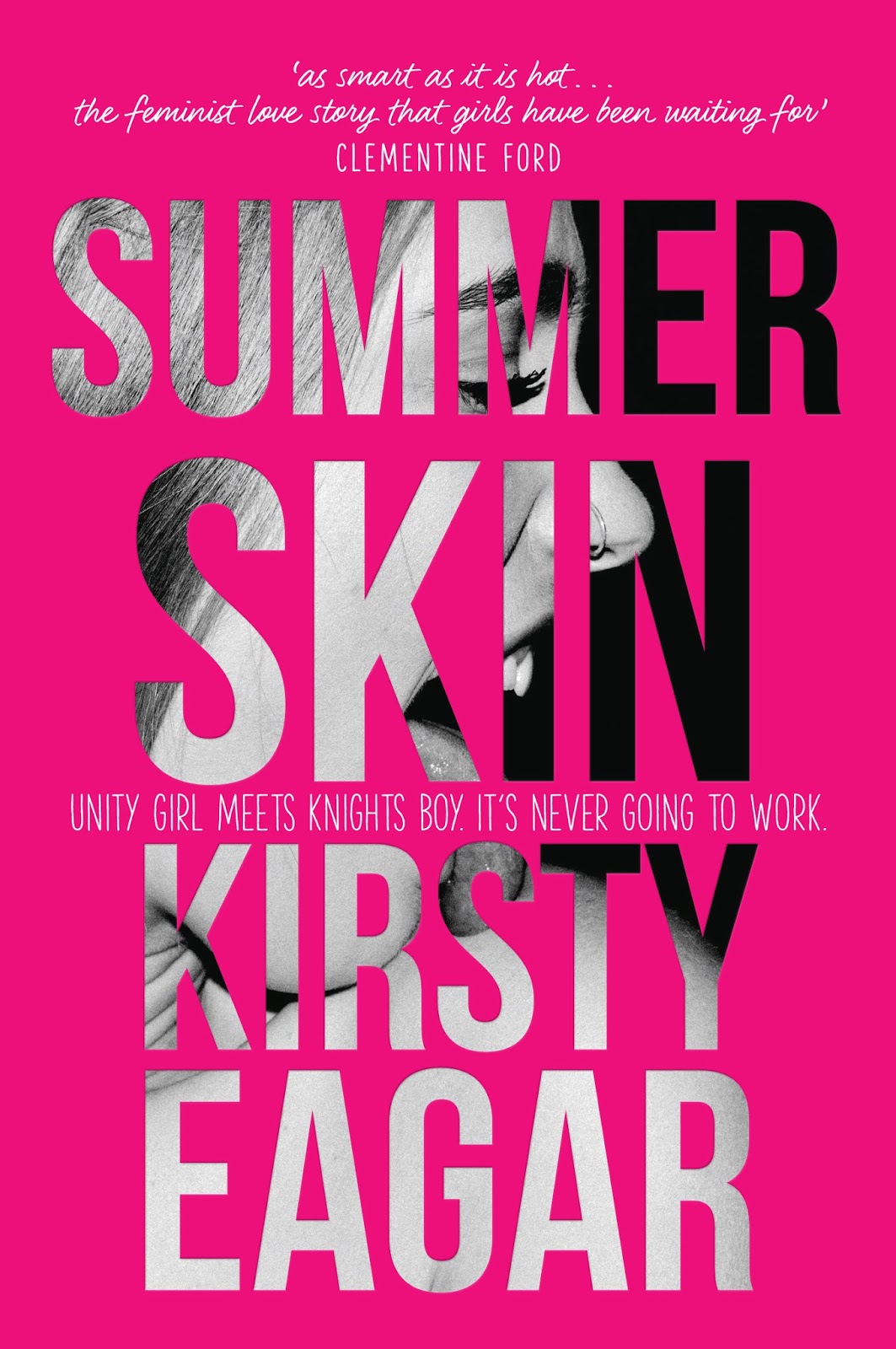
Summer Skin by Kirsty Eagar

Monday, March 21, 2016

*At the Melbourne launch, Kirsty mentioned the title of the novel being from Death Cab For Cutie's Summer Skin. (Which I love. I was quite the Death Cab For Cutie fan when I was seventeen.) Why not listen to it while you read my review? (Crooked Teeth is probably my favourite from that album, however...)*

Jess Gordon is out for revenge. Last year the jocks from Knights College tried to shame her best friend. This year she and a hand-picked college girl gang are going to get even.

The lesson: don't mess with Unity girls.

The target: Blondie, a typical Knights stud, arrogant, cold . . . and smart enough to keep up with Jess.

A neo-riot grrl with a penchant for fanning the flames meets a rugby-playing sexist pig - sworn enemies or two people who happen to find each other when they're at their most vulnerable?

It's all Girl meets Boy, Girl steals from Boy, seduces Boy, ties Boy to a chair and burns Boy's stuff. Just your typical love story.

I have read and loved each of Kirsty Eagar's previous novels. One thing that I especially admire about her work is the way in which she defies genre limitations; each of her novels is distinct, different. Every one of them is brave and original and, of course, very well-written. You never quite know what to expect when another one is published. And that's fantastic. When I found out Kirsty had a new novel coming out, I was very excited.

I was lucky enough to appear on a couple of panels with Kirsty's editor at National Young Writers' Festival last year, and she had advance copies of Summer Skin over which I oohed and ahhed. I may or may not have declared my love for the aforementioned editor when she said "You can keep that". And then clutched Summer Skin to my chest as if I had just discovered the Holy Grail.

I bought myself a finished copy of the novel at the Melbourne launch (held at Readings Carlton - my favourite bookshop in the universe). It was a double launch, along with Justine Larbalestier's My Sister Rosa, which I'm looking forward to diving into once I have a break from uni (all that Law reading has a way of frying your brain, preventing most other kinds of reading). It's always wonderful to get the chance to hear an author speak about their work, especially after having read the novel.

I will warn you that this novel is chock-a-block with sex scenes. When I got that first copy, I went down to the beach at Newcastle and started reading. And then reached one of those... um, interesting... sections, and looked about the beach, paranoid that people would know what I was reading. It felt like what I would imagine reading Fifty Shades of Grey out in public would feel like, which I would only do if every other book in existence had spontaneously combusted. Let's hope that doesn't happen.

Sex scenes. There's a lot of them. The characters are in their second year of uni, and there's sex and untoward language and drinking and smoking and a great deal of questionable behaviour. It's definitely for the older YA reader.

Is it an accurate reflection of the lives of young people? I've been the same age as the characters (quite recently) but I haven't lived in a college at uni. I presume it's an accurate depiction of that life but I couldn't personally relate to the characters on a lot of counts. Which is fine - I can still empathise with the characters even if they're not just like me. The setting reads as authentic, and the events which occur seem consistently realistic; it was easy to become immersed in their reality.

I loved that nothing about the novel was sanitised or minimised (so much drinking!), that the girls in the novel were unapologetic about enjoying sex, and that Jess, rather than being consistently likeable, was difficult and forthright and smart but still sometimes made poor decisions. There was a realism there; nobody is perfect at nineteen (or ever), not even intelligent, political girls. If you, like me, lead a life far tamer than these characters, it's a nice bit of escapism while still touching on issues that are universal when it comes to navigating relationships in young adulthood.

I love that it looks critically at slut-shaming, the misogynistic culture at some colleges (and uni in general), gendered sex expectations and the effects of porn, the all-pervasive impact of social media, women reclaiming their power... I never felt that it veered into being preachy or off-topic. Always relevant to the story. Consistently believable and engaging dialogue. It's not issues-based but it sure touched on a lot of issues. I would love to see a whole lot more feminist issues overtly dealt with in YA - a lot of YA is subtly feminist, but I loved that Summer Skin was so direct and political. (Because, after all, the personal is political.)

My only qualm? I was not a huge fan of Jess's love interest, Mitch. Your mileage may vary. Based on the reviews I've read, a lot of readers unreservedly love Jess and Mitch's relationship. I felt he consistently treated Jess poorly, and while his behaviour was later explained, I wasn't sure his and Jess's relationship ever became healthy. They're both flawed, realistic characters, and their relationship is complicated, but I was still not entirely comfortable with Mitch's treatment of Jess. It really comes down to reader interpretation, and Mitch was not my cup of tea.

Awesome upper YA fiction that I think will find many readers among adults; it's honest and raw and smart. I loved the dialogue, I loved the critical look at hook-up culture, I loved the flawed, unapologetic characters. It's intense. And definitely worth a read.

Summer Skin on the publisher's website.

Guest Review: On the Edge of Gone by Corinne Duyvis

Monday, March 14, 2016

Today, I bring you a guest book review from an amazing young writer! Wendy Chen is a writer and student from New South Wales. I met her at National Young Writers Festival last year, after emailing for years. Lately, I've enjoyed reading her thoughtful reviews over at online magazine that reminds me. She's written about Preloved by Shirley Marr and the depiction of minority charactersI Am Malala and the power of education and peaceful protest and Studio Ghibli's Whisper of the Heart and being an aspiring young writer. I thought it would be awesome to have her guest review here on the blog! So: here's Wendy's review of Corinne Duyvis' On the Edge of Gone!

--

Release date: 8th of March 2016

Rating: 8/10 (leaning towards a 9). Thank you to Netgalley and Amulet Books for the ARC.

January 29, 2035. That’s the day the comet is scheduled to hit—the big one. Denise and her mother and sister, Iris, have been assigned to a temporary shelter outside their hometown of Amsterdam to wait out the blast, but Iris is nowhere to be found, and at the rate Denise’s drug-addicted mother is going, they’ll never reach the shelter in time.
A last-minute meeting leads them to something better than a temporary shelter—a generation ship, scheduled to leave Earth behind to colonize new worlds after the comet hits. But everyone on the ship has been chosen because of their usefulness. Denise is autistic and fears that she’ll never be allowed to stay. Can she obtain a spot before the ship takes flight? What about her mother and sister? When the future of the human race is at stake, whose lives matter most?

I loved Corinne Duyvis’s debut novel, Otherbound, for its skilful writing and plot, so I was really excited for this book. The premise immediately hooked me, and I love apocalyptic stories when they are done well. The refreshingly diverse cast of characters was another factor in drawing me in.

First off, On the Edge of Gone’s greatest strengths were its narrative voice and the characterisation of its protagonist. Sixteen-year-old Denise is autistic, which, sadly, is rare to see in YA fiction; so, too, is the author, which is even rarer in comparison to problematic depictions of autistic characters I’ve seen from neurotypical authors in the past. So it was fantastic to read an ‘own voices’ story from the point of view of such a wonderfully constructed character. Her voice – an important element in first-person books and YA – was distinctive and memorable. Whilst I’m neurotypical and couldn’t personally identify with Denise in some ways that were specific to her autism, she was created with so much depth that I was on her side every step of the way, I felt every bit of her pain when she was put in situations or forced to do things that made her uncomfortable, and her vulnerability made her incredibly and personally relatable. Denise is also biracial (Surinamese/Caucasian) and this aspect was also depicted authentically.

The world-building, too, was top-notch. The book is set 20 years into the future, and thus has some updated technology (which were included logically and consistently) but on the whole, the world felt very familiar, which added to the apocalyptic atmosphere and the suspense.

I loved the moral themes that were woven throughout the novel. They felt natural, due to the situation – how do you decide who gets to live and who dies when humanity as a whole is threatened? What makes one person more valuable than another? Issues regarding the very nature of survival also ran throughout the story. Like the best books which do this, there is no overdone preaching or specific take-away message at the end; instead, there are questions that linger with you.

The book was also pleasingly inclusive in the range of characters featured – Black, queer, and Jewish characters, amongst others, are present, and in each case their identities were woven in naturally and felt very true to reality. The side characters were crucial to the storyline, as the thematic focus of the book meant that it centred on their relationships, interactions, and how they dealt with the apocalyptic situation. I connected and empathised particularly strongly with two of the characters, Anke and Max, whom Denise met aboard the generation ship – and there was also some great moral ambiguity in their motives and actions.

Based on these elements, the storytelling in the first quarter of the book was almost perfect. However, there were a few issues that came up later that prevented me from enjoying it completely.

Denise’s sister Iris, whom she spends much of the book looking for and trying to help, didn’t feel fleshed out enough to me. Iris makes some questionable actions throughout the story, and I found it hard to understand or side with her. That said, I thought it was insightful to see such a respectful depiction of a transgender character.

I was also uncertain of my attitude towards Denise’s mother. I felt sympathy and frustration towards her, like Denise did, but there wasn’t enough depth or connection to her beyond that. More backstory may have helped with this.

The final issue was the pacing. Whilst this was fine in the beginning and there was an effective build-up of tension – always enough to keep me reading – the middle of the book felt unnecessarily slow. After that, it sometimes felt like the storyline was going in circles and not moving forward enough. In the last quarter or so, the opposite happened – the plot sped up excessively. The ending could also have used more set-up – there were plot points which tied in that should have been established earlier on.

That said, I’m willing to overlook these more minor issues (pacing is often less of a concern for me upon reread, anyway) and highly recommend On the Edge of Gone. Fans of The Sky So Heavy by Claire Zorn should enjoy this!

Wendy Chen is a writer and student from New South Wales, with a particular passion for fiction, review writing and advocacy. She co-runs the  blog LoveOzYA on Tumblr, and is a contributor at That Reminds Me. You can find her website here.

Laurinda by Alice Pung

Wednesday, January 6, 2016

Laurinda is an exclusive school for girls. At its secret core is the Cabinet, a trio of girls who wield power over their classmates - and some of their teachers.

Entering this world of wealth and secrets is Lucy Lam, a scholarship girl with sharp eyes and a shaky sense of self. As she watches the Cabinet at work, and is courted by them, Lucy finds herself in a battle for her identity and integrity. 

Funny, feisty and moving, Laurinda explores Lucy’s struggle to stay true to herself as she finds her way in a new world of privilege and opportunity.

Laurinda read more like a memoir than a novel, particularly when it came to Lucy's family and home and the suburb where she lives. I mean this in the best way possible: it felt real. I felt totally transported into her life. I loved her Mum and her Dad and her baby brother, and her working class suburb, and her hilarious friends (pre-Laurinda). Like Fiona Wood's CloudwishLaurinda is about an Asian-Australian girl on a scholarship at a prestigious private school negotiating various relationships and working out who she is and where she fits in. I love and recommend both but if you want to read something romantic with a touch of magic, Cloudwish is the go. If you want something entirely of-our-world (and more centred on private-school hierarchies and the dynamics between young women), read Laurinda.

Laurinda focuses on Lucy finding her place at the eponymous school, and a big part of that is dealing with the manipulative Cabinet, a group of girls who effectively own Laurinda. Lucy is an endearing and likeable protagonist who finds herself in an incredibly privileged environment, dealing with huge pressures and expectations from family, her community and her school. The Cabinet are borderline-evil, and do some horrific things (I cringed), but are always believably depicted. Having not attended any exclusive schools for girls, I don't have the personal experience to say whether Lucy's experiences at Laurinda are representative of reality, but they certainly seemed authentic.

There is a preponderance in this novel towards big sudden realisations, and the amount of insight Lucy has into the dynamics within her school and among her peers is perhaps difficult to imagine a teenager in the midst of it all actually having; it reads like the viewpoint of an adult looking back on it all with the benefit of hindsight. However, this didn't take away from the authenticity of the novel nor my enjoyment of it. Lucy, as an outsider, has a perspective of Laurinda, its students and its teachers that those more accustomed to and embedded in the environment simply do not have - people with privilege (of all kinds) just don't have to think about things from the point of view of those without. (I found a scene where the Cabinet and their mothers invite Lucy over to make rice paper rolls especially reflective of this.)

This was one of my favourite novels of 2015. I would recommend Laurinda to all readers of contemporary YA, especially those who want a break from romance-centred stories. Laurinda is engaging and genuine and hopeful without being sentimental. It's one of the realest YA novels I've read in recent memory, just a really gorgeous coming-of-age story, and one that I think every young person who has ever felt like an outsider will relate to.

Laurinda on the publisher's website.

Cloudwish by Fiona Wood

Wednesday, December 30, 2015

For Vân Uoc Phan, fantasies fell into two categories: nourishing, or pointless. Daydreaming about Billy Gardiner, for example? Pointless. It always left her feeling sick, as though she'd eaten too much sugar.

Vân Uoc doesn't believe in fairies, zombies, vampires, Father Christmas - or magic wishes. She believes in keeping a low profile: real life will start when school finishes.

But when she attracts the attention of Billy Gardiner, she finds herself in an unwelcome spotlight.

Not even Jane Eyre can help her now.

Wishes were not a thing.
They were not.
Correction.
Wishes were a thing.
Wishes that came true were sometimes a thing.
Wishes that came true because of magic were not a thing!

Were they?

I read Cloudwish immediately after I read Alice Pung's Laurinda, which happened entirely by accident and was possibly a bad thing, because they were similar enough that I was constantly making comparisons as I read Cloudwish. Both novels about ridiculously smart girls attending private schools on scholarships, growing up Asian in Australia, acting as go-betweens for their migrant parents and the wider world, and working out their identities in the weird, complex realm of their schools. The similarity between these two novels diverges at the point where magic gets involved in Cloudwish.

The fact that a magical wish is so central to the plot of Cloudwish made it unreal; Laurinda was entirely of our world, which made it feel wholly authentic. So while I'd recommend both novels (and I am writing a review of Laurinda, so I won't go into too much detail about it here), Cloudwish is for readers after a more enchanting, romantic story, while Laurinda is more realistic. That said, Cloudwish does deal with real-world issues with a lot of tact and thoughtfulness (including asylum seekers), so it's more wonderful contemporary YA plus a bit of the unreal.

Cloudwish occurs in the same universe as Fiona Wood's two previous novels, Six Impossible Things and Wildlife; Vân Uoc attends Crowthorne Grammar, and familiar characters appear in this novel. You will of course love it if you enjoyed either of Wood's previous novels. Vân Uoc is a wonderful narrator. She is strong and smart and fierce. She was especially engaging in the sequences written in first-person; while most of the novel is written in third, I felt a little distant from her at times (especially because she is so smart).

I loved reading about a character who is Vietnamese-Australian, and the depiction of her family life, particularly her relationship with her mother, felt honest throughout. One of the most wonderful things about fiction is being able to read about people different from yourself, and to learn and empathise, and obviously this isn't possible if you're a middle-class white kid reading about middle-class white kids all the time. I would love to see more novels that represent how multicultural Australia actually is, and feature non-white protagonists.

I did not find Billy Gardiner an especially compelling love interest (you are way too good for him, Vân Uoc!), but found the exploration of their relationship engaging. It's different to how many relationships are drawn in YA fiction; it had a definite realism to it, despite the fact it was based off a magic wish. The complexity of socio-economic and cultural differences between them was well-depicted.

Cloudwish is a beautiful novel. The sort that makes you feel a little demoralised because you know you'll never write a novel so good. And by you I mean me. It's a romantic, magical, heart-warming contemporary YA, that's still real and down-to-earth. It's about identity and finding your place and accepting that good things can just happen. It's just really, really lovely.

('Cloudwish' keeps auto-correcting to 'Cloddish'... which makes no sense. When do I ever need to use the word 'Cloddish'? Now I've looked at the word Cloddish, I mean Cloudwish, so many times that it makes absolutely no sense and the letters 'ou' seem very strange to me.)

Cloudwish on the publisher's website.

Friday Brown by Vikki Wakefield

Wednesday, December 23, 2015

Seventeen-year-old Friday Brown is on the run—running to escape memories of her mother and of the family curse. And of a grandfather who’d like her to stay. She’s lost, alone and afraid. 

Silence, a street kid, finds Friday and she joins him in a gang led by beautiful, charismatic Arden. When Silence is involved in a crime, the gang escapes to a ghost town in the outback. In Murungal Creek, the town of never leaving, Friday must face the ghosts of her past. She will learn that sometimes you have to stay to finish what you started—and often, before you can find out who you are, you have to become someone you were never meant to be.


I am really, really jealous of Vikki Wakefield because Vikki Wakefield writes these extraordinarily authentic novels that are also profoundly poetic and have a surreal edge. I just read her new one, In-Between Days, which was wonderful (review forthcoming!) and which prompted a reread of Friday Brown


If you are not familiar with Wakefield's work, Friday Brown is the sort of novel frequently described as gritty, but the word gritty just makes me think of the stuff in the bottom of fish tanks, rather than such an excellent book. It would probably be best described as contemporary YA, but it transcends that categorisation; I wouldn't hesitate to recommend it to adult non-YA readers (though really, everybody should be reading YA because it is the best) as well as YA readers fifteen and up. You probably want to be emotionally ready for it, though. It will put you through the wringer. 

It is a dark novel, and that darkness is never shied away from; characters are difficult and flawed and sometimes dangerous, but always well-characterised. Friday is a particularly compelling character. The atmosphere is incredible, particularly the outback ghost town; something I could clearly picture in my mind. I think this novel would be extraordinarily well-suited to film. The writing is beautiful throughout. Some of the content is pretty confronting, as it's a novel about a gang of homeless youth, the leader of which has worrying intentions and motivations, but it's always well-depicted, and violence and crime are never glorified.

My only disappointment with this novel was that, in a way, the ending felt unrealistic for such a grim novel. After all of the awful preceding events, to have such a hopeful and sentimental ending didn't quite fit. On the other hand, a novel that is unrelentingly dark isn't really typical of YA; even though a darker ending might have felt 'realer', it was a relief for goodness to ultimately be acknowledged. 

I spend a lot of time thinking about what defines YA as YA (which, yes, is a pointless endeavour) as well as about what makes for satisfying endings of stories. Half of the experience of a novel is down to the reader and their perspective and experiences; as a younger reader I probably would have felt the ending of this novel was perfect (and I wanted, to a greater degree, to read novels with uplifting endings, and read almost exclusively YA), whereas now I'm a bit older, I don't mind a bleak ending as much. Sometimes I prefer them. So my comments on the ending are only really a matter of interpretation; the next time I reread Friday Brown I will likely feel differently about the ending again.

Friday Brown is evocative, beautifully-written, dark and heart-wrenching and ultimately hopeful. Yet another example of amazing Australian contemporary YA; the sort of novel you will stay up all night reading, and then have to sit with for a few minutes, once it's over, to let all the feelings settle.

Friday Brown on the publisher's website

What We Left Behind by Robin Talley

Monday, December 14, 2015

Toni and Gretchen are the couple everyone envied in high school. They've been together forever. They never fight. They're deeply, hopelessly in love. When they separate for their first year at college—Toni to Harvard and Gretchen to NYU—they're sure they'll be fine. Where other long-distance relationships have fallen apart, their relationship will surely thrive.

The reality of being apart, however, is a lot different than they expected. As Toni, who identifies as genderqueer, falls in with a group of transgender upperclassmen and immediately finds a sense of belonging that has always been missing, Gretchen struggles to remember who she is outside their relationship.

While Toni worries that Gretchen, who is not trans, just won't understand what is going on, Gretchen begins to wonder where she fits in Toni's life. As distance and Toni's shifting gender identity begin to wear on their relationship, the couple must decide—have they grown apart for good, or is love enough to keep them together?

I am very excited by the number of YA novels currently being published that centre on LGBT characters. I am even more excited at the quality. I think there's a risk in books for young people of sounding preachy, or of allowing 'issues' to be the focus at the expense of the story, but I've found that occurring less and less in YA as I've gotten older (and I suppose as YA as a genre has developed and the segment of the market it inhabits has expanded). I think it's wonderful that so much more YA represents the diversity and experiences of actual young people, rather than some distorted worldview where everyone looks and acts exactly the same. What We Left Behind is a terrific example of this.

The writing style is simple, conversational and straight-forward, so it's a quick and easy read. It's engaging enough to be a read-in-one-sitting novel. While I can't speak to the truth of Toni's experiences and depiction as a transgender character, this always read as being honest and realistic; I found the characters exploring the complexity of using gendered/non-gendered pronouns for others really interesting, and the dialogue between Toni and friends authentic and engaging. Both protagonists are endearing, though much of the story centres on Toni, who undergoes the biggest change in identity, sometimes at the expense of Gretchen (who is super nice and lots of unpleasant things happen to her that she so doesn't deserve. She's a sweetheart). I love YA romance that focuses on an established relationship, and the difficulty Toni and Gretchen had maintaining their relationship when separated at different schools felt realistic; I very much wanted things to work out for them.

I would definitely recommend this for the older YA reader, especially if you like YA centred around university-aged characters, and all of the dilemmas that go along with that. While it is a novel about a lesbian couple, someone trying to working out their gender identity and centres around a number of transgender characters, it's also about identity and managing the transition from high school into adult life, so it's not just for fans of LGBT YA. It's immensely readable and heartwarming. (Heartwarming in the end, I should say - there's some pretty awful, dig-your-nails-into-your-palm angry stuff before then. Especially because you know transgender people are treated with disrespect in real life, too, which is absolutely unacceptable.)

(Side note: I tend to read much more Australian YA than American YA which I'm aware is probably uncommon - which it shouldn't be, in Australia! Australian YA is the best! - so I was struck by how American everything is. Harvard! New York! Living in dorms! They have dorms in Australian unis, too, but still. This is a distinctly American novel.)

What We Left Behind on the publisher's website

Burn by Paula Weston

Wednesday, November 11, 2015

Suddenly, Gaby remembers everything.

For a year she believe she was a backpacker chilling out in Pandanus Beach. Working at the library. Getting over the accident that killed her twin brother.

Then Rafa came to find her and Gaby discovered her true identity as Gabe: one of the Rephaim. Over a hundred years old. Half angel, half human, all demon-smiting badass and hopelessly attracted to the infuriating Rafa.

Now she knows who faked her memories, and how—and why it’s all hurtling towards a massive showdown between the forces of heaven and hell.

More importantly, she remembers why she’s spent the last ten years wanting to seriously damage Rafa.

Enjoyable, epic and vividly realised, Burn is a satisfying conclusion to the Rephaim series; a series which, I believe, has become stronger with every instalment. It takes well-worn concepts in paranormal fiction (there are a lot of fallen angels in YA) but still manages to offer a fresh perspective and solid mythology. I think the setting in particular is wonderful in this novel; it incorporates international locations while still having a distinctly Australian edge.

I have a little trouble reviewing paranormal fiction, largely due to the fact that I read a great deal more on the contemporary end of the spectrum and tend to prefer stories set in the real(er) world; I worry that I am not, perhaps, the ideal audience, due to my low tolerance level for melodramatic supernatural creatures and over-long series. I need not have worried this would be the case with Burn; this novel is fast-paced and melodrama is kept to a minimum. Nothing is excruciatingly drawn-out as I think can be a temptation for writers with series that feature extensive casts of characters with complex histories. The ending is hopeful, and though a bit sentimental for my tastes, it's a fitting conclusion.

If you enjoy paranormal YA/novels about fallen angels, and are looking for your new favourite series, this one is well worth checking out. (Now that the final novel has been published, there's no painful wait for the next instalment - nothing to stop you from binge-reading the entire series in one go, if you like.) If you read the first book in the Rephaim series and aren't sure whether to pick up the next, do. Burn is my favourite novel in the series; I especially loved the cinematic battle scenes toward the end. This is exactly the sort of paranormal YA I love, and I look forward to seeing what Paula Weston writes next.

Burn on the publisher's website.

In the Skin of a Monster by Kathryn Barker

Monday, November 2, 2015

Three years ago, Alice's identical twin sister took a gun to school and killed seven innocent kids; now Alice wears the same face as a monster. She's struggling with her identity, and with life in the small Australian town where everyone was touched by the tragedy. Just as Alice thinks things can't get much worse, she encounters her sister on a deserted highway. But all is not what it seems, and Alice soon discovers that she has stepped into a different reality, a dream world, where she's trapped with the nightmares of everyone in the community. Here Alice is forced to confront the true impact of everything that happened the day her twin sister took a gun to school ... and to reveal her own secret to the boy who hates her most.

This is the weirdest book I have read all year and I have read some weird books this year (weird books are my favourite books). The majority of this novel occurs in a dreamscape. Literally. Not a metaphor. This dreamscape that Alice finds herself in fills, every night, with the nightmares of the people of her town. These appear in bubbles which, if popped, release nightmarish creatures and dream-versions of real people into the dream realm. I really love the concept (dream realms are my favourite realms) and the setting is vividly expressed. It's creepy and atmospheric and surreal.

I think what's really extraordinary about this novel is the way it so smoothly incorporates the bizarre and the realistic. It's both fantasy and contemporary; everything that happens in the dreamscape is inextricably linked to Alice's real life tragedy. I think writing about youth and crime requires a bit of gumption; it's so easy to mishandle or accidentally glorify terrible things in fiction, seeing as so much of the experience of a novel is dependent on the reader. I don't believe that people who write for teenagers have some sort of duty to protect or educate children, and I think any story that is agenda-driven is bound to fail, but glorifying violence is never a good look. In the Skin of a Monster features a protagonist whose twin committed a mass murder, and is predominantly about how Alice (and other people affected) comes to terms with this; considering the profoundly difficult subject matter, I think the themes of grief and loss and trauma are all explored frankly but still tactfully. I had a few little niggles with plot points that didn't quite ring true to me, but ultimately I was impressed; an awesome concept, really well-executed. It definitely offers something different, and that's a very welcome addition to YA fiction, in my opinion.

It's surprising and engaging and original. It's a dark novel, but there's still a hint of hopefulness at the end (I wasn't too depressed after I finished reading). One for older YA readers. Definitely worth a look if you enjoy both fantasy and contemporary YA.

In the Skin of a Monster on the publisher's website.

The Cut Out by Jack Heath

Monday, October 26, 2015

Fero isn't a spy.

But he looks exactly like someone who is: Troy Maschenov - a ruthless enemy agent.

But what starts as a case of mistaken identity quickly turns into a complicated and dangerous plan. Fero is recruited to fight for his country. He will have to impersonate Troy, enter enemy territory, hunt down a missing agent and bring her home in time to prevent a devastating terror attack.

Fero is in way over his head. Hastily trained, loaded up with gadgets and smuggled across the border, he discovers the truth about espionage.

Getting in is easy. Getting out alive is hard.

The Cut Out is set in Besmar and Kamau, two small countries wedged between Ukraine and Russia. I was not 100% sure that these were fictional countries, so I may have scrolled around on Google Maps for a bit, thinking perhaps there's some basis in reality. Which I think speaks highly of the attention to detail and authenticity when it came to the setting. Either that, or my total inability to distinguish between fiction and reality. It requires some suspension of disbelief to buy that a fourteen-year-old who has been picked up off the street would be sent off on a secretive mission within a matter of hours, even in a foreign (and fictional) country; it becomes clear why this occurs at a later point, but in the meantime I was very concerned for Fero's welfare. Maybe I'm getting old.

While it's fast-paced and action-packed and all those adjectives an adventure novel for young people should be, I think it also explores themes that are relevant in the real world with quite a lot of nuance and subtlety - like how conflicts change depending on your perspective, and how information is manipulated by the media (I was reminded of 1984, and how the country they were at war with, and had always been at war with, changed on a regular basis). Having read Jack Heath's novels since 2008, I think it's clear how much he has developed as a writer - even though he continues to write in the same genre, there's nothing stagnant about his work. I think it can be a risk in any genre for certain writers, once finding success, to keep producing the same novel every year; that's not the case here.

I think a lot of kids go through a phase of wanting to be a spy - as a ten-year-old I loved the Max Remy: Superspy series (I met Deb Abela, the author, when I was fifteen, and I almost fainted), and was obsessed with spies and codes and eavesdropping. The Cut Out would especially appeal to these readers. It has some very intense scenes, so I'd recommend it for upper primary readers and up; I think my twelve-year-old self would probably enjoy it most, but it depends on the reader. It certainly appeals to me as a twenty-one-year-old reader, too.

I'm very much looking forward to the sequel to The Cut Out, and seeing where Fero's story goes next. Mainly I hope there's more twists. The twists are the best part.

The Cut Out on the publisher's website.

Another Day by David Levithan

Friday, October 16, 2015

Every day is the same for Rhiannon. She has accepted her life, convinced herself that she deserves her distant, temperamental boyfriend, Justin. She’s even established guidelines by which to live: Don’t be too needy. Avoid upsetting him. Never get your hopes up.

But one morning everything changes. Justin wants to be with her for the first time, and they share a perfect day—a perfect day Justin doesn’t remember the next morning.

Confused, depressed and desperate for another great day, Rhiannon starts questioning everything. Until a stranger tells her that the Justin she spent that day with—the one who made her feel like a real person—wasn’t Justin at all.

Another Day is a companion novel to Every Day, which I loved, and features the same events told from the perspective of love interest Rhiannon. You can read Another Day even if you haven't read Every Day, in fact, I think you should read Another Day first.

Basically it's about a person, A, who wakes up every day in a different body, who falls in love with a normal human being, Rhiannon. Which is problematic. It's a compelling concept but A's perspective is naturally the more interesting one, seeing as Rhiannon is consistently the same person. And a person who is frustrating in her inability to stand up for herself, even if she does seem like an accurate reflection of a real sixteen-year-old. She's likeable, but she never really seems to be in charge of her own story, instead having her life controlled either by her boyfriend Justin, or by mysterious (ghosty?) A; I would've preferred a story where she realised she was perfectly okay on her own, without a boy, or a genderless spirit, having to love and validate her. But that's just the sort of story I would like, and what the story actually is is still engaging. It evokes obsessive teenage romance very well. It's certainly very readable, conversational in tone while still being well-written.

Rhiannon is a well-developed character in her own right; this isn't a shameless money-grab Fifty Shades of Grey as-told-by what's-his-name or gender-flipped Twilight, but an engaging story in it's own right, offering a different perspective of the events. It explores gender and sexual orientation in a really interesting way; things that couldn't, to the same degree, be explored from A's perspective. It's definitely worth reading, and it functions wonderfully as contemporary YA with a paranormal twist, but it pales a little next to Every Day, which I thought was a real stand-out. The story I really wanted to read was what happens after the end of Every Day, rather than the same events from Rhiannon's perspective... fortunately that sequel is going to be published.

That said, this is an enjoyable novel with an authentic teenage voice, and it's pretty tricky to stop reading it. I'd recommend it to fans of both contemporary YA and paranormal YA; it combines the two wonderfully. The concept is brilliant. If you liked Every Day, you'll like this, and vice versa. And I really, really want to know what happens next.

Another Day on the publisher's website.

Steal My Sunshine by Emily Gale

Wednesday, September 16, 2015

During a Melbourne heatwave, Hannah's family life begins to distort beyond her deepest fears. It's going to take more than a cool change to fix it, but how can a girl who lives in the shadows take on the task alone? 

Feeling powerless and invisible, Hannah seeks refuge in the two anarchists of her life: her wild best friend, Chloe, and her eccentric grandmother, Essie, who look like they know how life really works. 

But Hannah's loyalty to both is tested, first by her attraction to Chloe's older brother, and then by Essie's devastating secret that sheds new light on how the family has lost its way. 

Even if Hannah doesn't know what to believe in, she'd better start believing in herself.

I can't stop this amazing one-hit wonder from playing in my head while I'm working on this review (1999... what a year for music). Trouble is, that song isn't right for the tone of this novel. And now I'm trying to work out what song is right I've discovered that's an impossible task and I can't possibly find the perfect song.

You can't tell but I've just spent half an hour trying to find the perfect song to match this novel and it's just not happening. The best I can do is suggest a combo of One Crowded Hour by Augie March and Songbird by Bernard Fanning and hope that conveys it. Musically, rather than lyrically. It's got all this aching sadness, fairly heartbreaking in parts, but then that hope at the end. I guess I should write the review now.

Hannah is lovely: shy, uncertain and yearning, a character whom I think a lot of young readers will be able to relate to. Difficult family dynamics are explored with realism and subtlety, as Hannah's family crumbles around her. The characterisation is excellent - every character is unique and flawed, from Hannah's sweet and tortured dad, to her (understandably) rage-filled mum, to her out-there best friend Chloe. (I was furiously angry with her mother and brother, and their totally uncalled for meanness towards Hannah. Why would you be so awful? Hannah's a sweetheart, gosh.)

The unraveling of the mystery in Hannah's family, allowing Hannah to understand why things are so difficult between Essie and her daughter (Hannah's mum), kept me reading into the early hours of the morning. Essie is a wonderful character, and I could so clearly picture her and her house. Her story is the most compelling part of the novel, and reads as very authentic. It's incredibly tricky but important subject matter - single mothers being forced to give up their babies, something that occurred for decades in Australia's not-so-distant history - and is dealt with so well. Essie's narrative is at times harrowing, often heartbreaking, with a distinct and engrossing voice. It never feels like it's being educational, but I think it would be a great novel to study in school, and not just because of the historical content.

While there is romance (Hannah has a crush on her best friend's older brother, Evan), the romance isn't even really about the romance - it's about Hannah working out who she is and what she wants, instead of being a passive observer in her own life. I think it's a much more true-to-life depiction of teenage romance than a lot of YA. Similarly, her friendship with Chloe - and the subsequent breakdown of it - reflects the difficulties of real-life teenage friendships; where, sometimes, friends simply outgrow each other.

If you expect things to be perfectly resolved, you'll be disappointed; Steal My Sunshine is realistic in that it depicts the true messiness of life. Steal My Sunshine blends the historical and the contemporary perfectly. It's a novel with huge sadness and a lot of heartbreak, but it's ultimately hopeful. Immensely readable.

Steal My Sunshine on the publisher's website

A Small Madness by Dianne Touchell

Wednesday, September 9, 2015

Rose didn't tell anyone about it. She wondered if it showed. She looked at herself in the mirror and turned this way and then that way. She stood as close to the mirror as she could, leaning over the bathroom basin, looking into her own eyes until they disappeared behind the fog of her breath. Looking for something. Some evidence that she was different now. Something had shifted inside her, a gear being ratcheted over a clunky cog, gaining torque, starting her up. But it didn't show. How could all of these feelings not show? She was a woman now but it didn't show and she couldn't tell anyone.

This book. Intense. Horrifying. Incredibly well-written. (It's the first time in ages I've read a YA novel where I had to look up words, which I love - learning new words is the best.) I think just as many readers of adult literary fiction would enjoy this as readers of YA fiction (I think a lot of YA fiction transcends what people stereotypically think of as YA fiction - this novel is a great example of that). I can't say I enjoyed it, because it deals with events that are downright awful, and characters that behave in some pretty horrendous ways, but it's an impressive novel.

Rose's best friend Liv is the most likeable character (and the most sensible). The actions of Rose herself are often incomprehensible (hence the 'madness' bit). Credibility stretches a little when it comes to the ignorance around sex and pregnancy displayed by the central characters, given they're seventeen-year-olds in modern Australia, who seem middle-class and not strictly religious. (It had a feel of being set in the past, though it wasn't; had it been, it might have been more believable.) It reads as a cautionary tale, but it's not at all moralising.

If you're sensitive to issues around teenage pregnancy and miscarriage, and you like your YA novels cheerful and uplifting, this might be one to miss. I'm not prone to recommending younger readers away from certain novels - I read YA fiction from the age of ten, and though I liked to steer away from dark, unpleasant stuff back then, but that might not be the case for all readers - as you'd know your own limits in terms of novel content better than I would, obviously. That said, I do think older teenaged readers and adult YA readers are much more likely to appreciate this novel. It's a very compelling read, and the writing is magnificent, but it's also incredibly confronting.

A Small Madness on the publisher's website
Proudly designed by Mlekoshi playground